John O. Harney: Immigration and geometry intersect on the Greenway in Boston
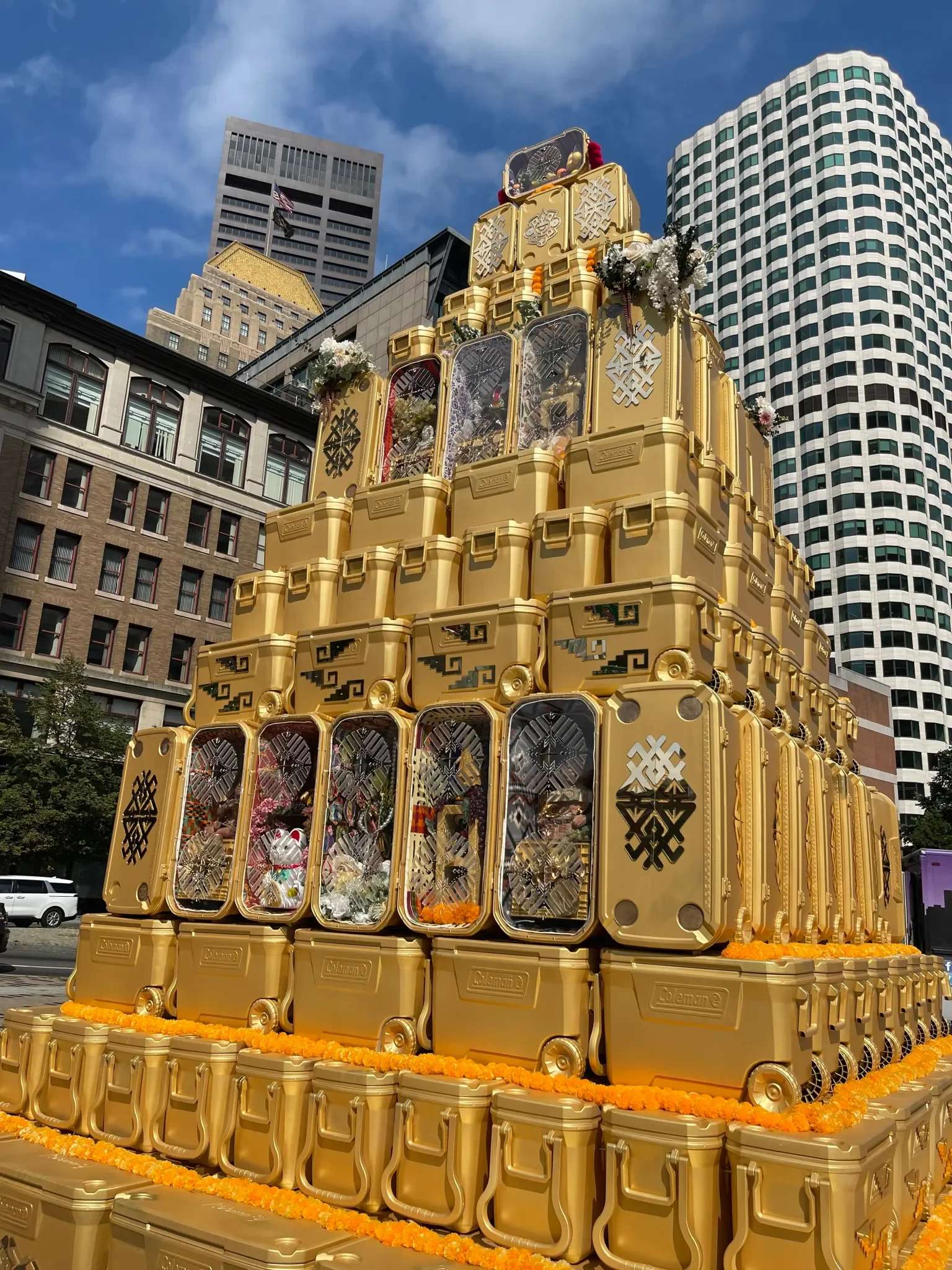
Art installation near Dewey Plaza, in downtown Boston, by Brooklyn-based artist Victor “Marka27” Quiñonez, featuring coolers spray-painted gold and images reminiscent of Mexican folk-art altars.
Early this fall, I took up an offer from the folks at the Armenian Heritage Park to present a lesson connecting immigration and geometry in the context of the Rose Kennedy Greenway, in Boston.
The lesson is part of a grant-funded curriculum developed by the Friends of the Armenian Heritage Park in collaboration with the 4th grade teachers at Boston’s Eliot K-8 Innovation School. The curriculum has been implemented in more than a dozen other public schools in Boston and beyond with funding for bus transportation from the schools to the Greenway.
The intent of the curriculum called “Geometry as Public Art: Telling A Story” is to spark awareness of geometric shapes and their expression of ideas and thoughts, and to engage students in sharing their own or their families’ immigrant experience and, in doing so, celebrate what unites and connects us.
It’s all very warm and loving despite the masked ICE agents operating a few hundred years away—and the general anxiety and avoidance of the topic a few miles beyond.
The event organizers provided a script for me to memorize. I was tempted to mention that even in my pre-retirement professional days, I always resisted speaking from a script and, in those days, urged others to resist, too. But also appreciating a crutch, I went along.
Another challenge: I hated geometry in school. Sure, I had done OK in math grade-wise and later published work in The New England Journal of Higher Education (NEJHE) on the importance of school math if only to help ensure that students pursue education beyond high school as an entry to good jobs.
But I couldn’t call it a special strength.
The twain shall meet?
I left the NEJHE editorship in early 2023 and began volunteering in phenology at the Greenway, in Boston, and in English language teaching at the Immigrant Learning Center (ILC) in Malden, Mass.
I have posted occasional reflections on the Greenway gig in my blog. I’ve posted less about the ILC experience. I’ve worried about drawing attention to the immigrant students who are made vulnerable by America’s xenophobia and advancing nationalism. Here though was a rare chance to see these two interests meet.
I have occasionally suggested that groups from the ILC tour the Greenway. Understandably, the newcomers thought that my Greenway garden work had to do with growing crops for food, not the more First-World idea of gardening for aesthetics associated with the Greenway.
Beyond the Armenian Heritage Park, the larger Greenway features notable recognition of the importance of immigration. Theoretically, other parcels along the Greenway were intended to celebrate the immigration flavors of their neighborhoods, as the Chinatown parcel does well with its bamboo planting, waterfall and recirculating stream.
Most recently, an art installation near Dewey Plaza by Brooklyn-based artist Victor “Marka27” Quiñonez, featuring coolers spray-painted gold and images reminiscent of Mexican folk art altars, paying tribute to the various groups of immigrant that have journeyed to Boston.
The Armenian geometry engagement also gave me an excuse for a mid-October visit to the Greenway for my routine bloom monitoring. It’s a time when few flowers are blooming, but there is that beauty unique to New England fall (if you’re OK with the approaching cold).
Amid the wilting astilbes, browning goldenrods and now hit-and-miss hydrangeas, a few colorful attractions remain. Among them: fall crocuses flowering pale bluish, vivid pink anemones, pink turtleheads, fluffy white snakeroot, nasturtium, isolated amaranths, resilient Russian Sage, purplish asters and red-fruiting winterberries.
The curriculum
The multidisciplinary curriculum in the Armenian Heritage Park integrates geometry, art, language and social studies while promoting cross-cultural understanding and respect.
The way it works: In Lesson One in the classroom, students discover geometric shapes, view info about the park and receive an “About My Family” questionnaire to guide a conversation with a family member or friend to learn about the first person in their family to come to the U.S.
Lesson Two (the one I was involved with) takes place at the park, where students experience firsthand how the park’s geometric features tell the story of the immigrant experience. They view an abstract sculpture, a split rhomboid dodecahedron, which is reconfigured every year to symbolize the story of the immigrant experience, “one that unites and connects us.” (The 2025 reconfiguration was scheduled for Oct. 19.)
The split rhomboid dodecahedron sits on a reflecting pool. An inscription notes: “The sculpture is dedicated to lives lost during the Armenian Genocide of 1915-1923 and all genocides that have followed.”
The water of the reflecting pool washes over the sides and re-emerges as a single jet of water at the center of the labyrinth (at least until the city turns off the water in mid-October as colder weather sets in).
The labyrinth celebrates life’s journey. The labyrinth serves as a place for meditative practice to reduce stress (though 4th-graders liberated by a field-trip day naturally relieve their stress by jumping and horsing around). There is one path leading to the center of the labyrinth and the same path leading out, symbolic of a new beginning, but clearly connected to where it began. The jet of water at its center represents rebirth.
The few calm students read the inscription on a reflecting pool on which the sculpture sits.
Ideally, the students discover the words etched around the: art, science, service, commerce in recognition of the contributions made to life and culture.
Students then write a wish on a ribbon for “The Wishing Tree.”
Back in the classroom for Lesson Three, students reflect on their visit to the park and receive the “I AM” poem template to create their poem, using an About My Family questionnaire. The poem is written in the voice of the first person in their family (sometimes the student) to come to this country. Students also create a portrait of that person or a geometric illustration.
Some messages on the Wishing Tree show hope, some signal worries. One youngster tackling his packed lunch, tells a friend, “things will be bad for four years because of Trump.” And indeed, these school kids, like so many across America, have the complexions that make them targets today.