
The perfumes of Maine

Boothbay Harbor
On that Italian hilltop, winter after winter, i have been almost insupportedly homesick for Maine scenes and scents: for the fresh, fragrant sea breeze, compounded of the essences of cool damp sand and moist brown seaweed; for the keen perfume of dying sweet grass in the haying season; for the springtime odors of lilacs, mallow and young willow trees; for a smooth gray beach at the mouth of a tide river, and the raucous screams of mackerel gulls above it, hunting sand-eels; for the scent of autumn leaves, the sound of a bird-dog ranging an alder swale, the thunder of a rising partridge; for a lamp-lit kitchen and the steamy, appetizing odor of baked beans and new bread.’’
—- Kenneth Roberts (1885-1957, American writer, best known for historical novels

Grace Kelly: What's meant by the 'blue economy'?

The area within red is Narragansett Bay.
From ecoRI News (ecori.org)
Blue is the new green.
The term “blue economy” has been popping up in headlines and economic outlines with increasing frequency during the past 10 years. But what exactly does blue economy mean? And what does it specifically mean for Rhode Island, the self-proclaimed Ocean State? And, to further complicate matters, what does it mean in a COVID-19 world?
A report released in March by the University of Rhode Island Graduate School of Oceanography, URI’s Coastal Resources Center, and Rhode Island Sea Grant attempts to answer the first two questions — the coronavirus pandemic hadn’t yet emerged during the report’s research period.
Jennifer McCann, director of coastal programs at the Coastal Resources Center, said that state government asked her team to define Rhode Island’s blue economy.
“So I Googled it, of course, and you get the definition from the U.N. and from other big, global programs and from different countries, and then you look at the definitions from different states like California and Michigan, and then you can go down further, and even Cape Cod has a definition of the blue economy,” she said. “Then our team looked at what data was out there, and we interviewed more than sixty people to figure out what they thought Rhode Island’s blue economy is, and so now we have a different definition than anyone else.”
Turns out Rhode Island’s blue economy, which the report defines as “the economic sectors with a direct or indirect link to Rhode Island’s coasts and ocean — defense, marine trades, tourism and recreation, fisheries, aquaculture, ports and shipping, and offshore renewable energy” — has a boatload of potential.
According to the 86-page report, 6 percent to 9 percent of Rhode Islanders work within the state’s ocean-based economy, which is valued at more than $5 billion.
Each sector listed in the report’s definition brings its own strengths to the table.
Ocean-based tourism raked in a whopping $703.6 million in 2018.
According to a 2019 study by Bryant University, the shipping industry at the Quonset Business Park generates nearly 7 percent of the state’s gross domestic product.Narra
The defense industry in Rhode Island uses certain areas of Narragansett Bay as testing grounds for new underwater technologies.
“The U.S. Navy owns an underwater tracking range located in Narraganset Bay. It is a testbed for undersea technology prototypes,” Molly Donohue Magee, executive director of the Middletown-based Southeastern New England Defense Industry Alliance, wrote in an email to ecoRI News. “The Naval Undersea Warfare Center has hosted an annual event, Advanced Naval Technology Exercise (ANTX) where companies can demonstrate their technology and prototypes to Navy engineers and the fleet.”
She goes on to note that ocean technology is the next big thing, and it will provide the state with an opportunity to strengthen its blue economy.
“Rhode Island is the hub of undersea technology,” she wrote. “It’s the home of the Naval Undersea Warfare Center, the Department of Defense’s research laboratory for undersea technology. There are many companies in Rhode Island and the region with unique technology related to the undersea environment. The ocean is the next frontier.”
Catherine Puckett is the owner of the Block Island business Oyster Wench, a shellfish and kelp farm operation. (Coastal Resources Center)
Deep blue economy
In addition to the obvious sectors of the blue economy, McCann made sure to note there are parts of it that might not seem so apparent, like advocacy groups such as Save The Bay or state agencies such as the Coastal Resources Management Council (CRMC).
“[Y]ou can’t forget about the marine-focused advocacy and civic groups,” McCann said. “And then you look at the role our government agencies have been playing whether it be Real Jobs RI working directly with marine trades and defense and building capacity, or CRMC who is designing our coast so we can have a pristine environment as well as a working waterfront.”
A big takeaway from the recent report, as well as from the state’s most-recent long-term economic development plan, which was approved in January, is that there is room for improvement.
During a January Rhode Island Commerce Corporation meeting that discussed the long-term economic development plan, titled Rhode Island Innovates 2.0 and written by Bruce Katz, Gov. Gina Raimondo is quoted as saying, “Basically, his analysis is: ‘Listen, you’ve made a lot of progress the past few years. But still a relatively small portion of our economy is what I would call advanced — high wage, high skill.’”
The governor went on to say that the state needs to do more to advance the education and skill of the average Rhode Islander.
Tide is high
While growing the blue economy was already seen as somewhat of an uphill battle, the coronavirus pandemic has thrown another obstacle in the way.
For instance, as of April 24, Discover Newport, a nonprofit dedicated to promoting the city of Newport and its ocean-centric tourism industry, had laid off 18 of its 22 employees, and expects to see a fall in annual revenue from $3.7 million to a little over a $1 million.
A variety of organizations that fall within the blue economy, such as Rhode Island Marine Trade Association, the Rhode Island Hospitality Association, Polaris MEP, and the Southeastern New England Defense Industry Alliance, have recently banded together to try to revive the economic momentum lost.
For McCann, this collaboration was always essential to a thriving blue economy, even before the virus took its economic and public-health toll.
“We need to work together,” she said. “That’s the way we are going to sustainably grow our state. If we just focus on economics or higher-ed, we’re not efficiently moving forward for sustainable growth in our state.”
Grace Kelly is an ecoRI News reporter.
Friendly or not?

“Moon and Islands’ (oil on panel), by Lucy Clark, in the group show “A Season of First Landings,’’ at Berta Walker Gallery, Provincetown, Mass.
Troubled June night
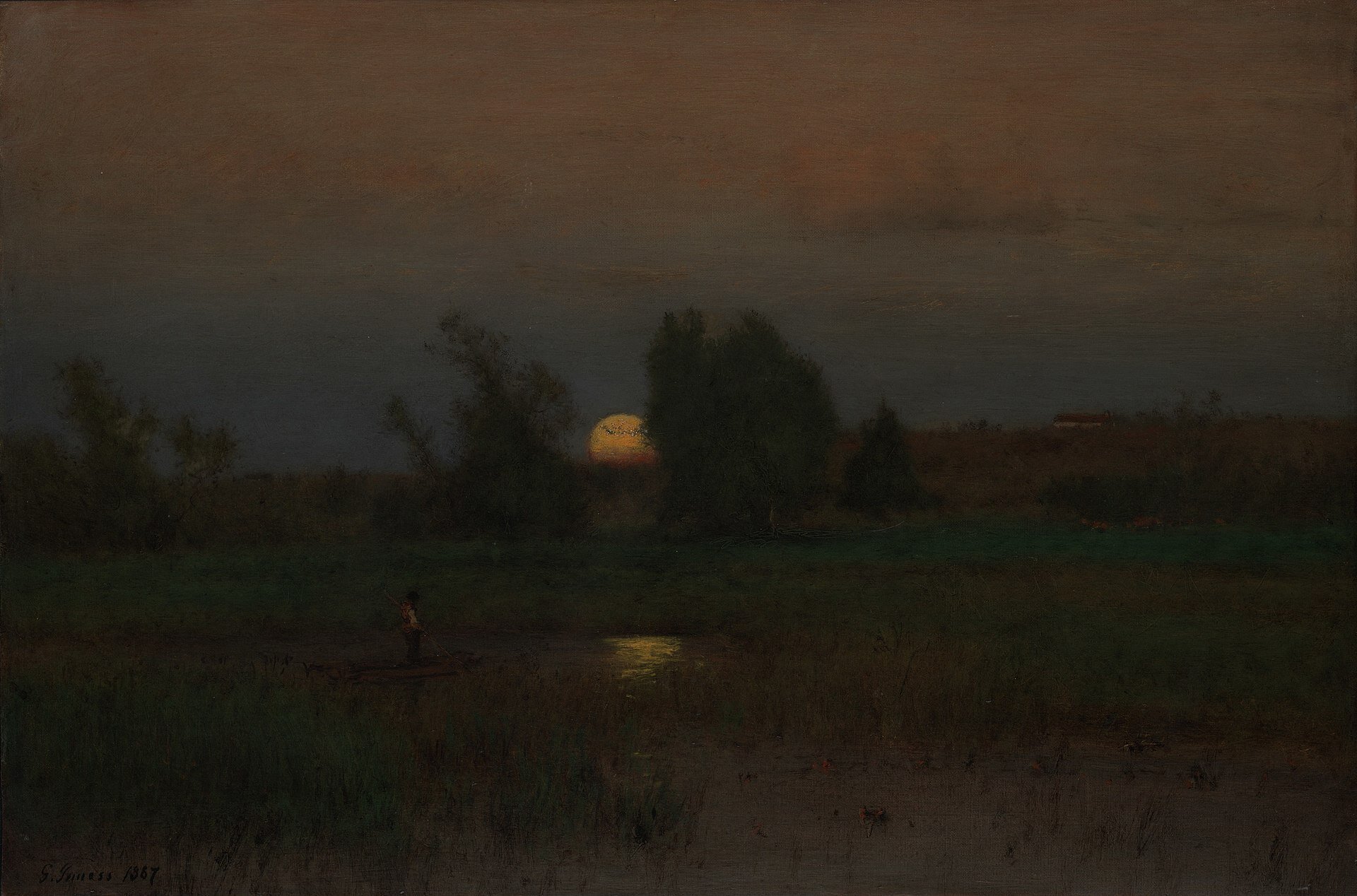
“Moon Rising’’ (oil on canvas), by George Inness (1825-1894)
Oh Earth, you are too dear to-night,
How can I sleep while all around
Floats rainy fragrance and the far
Deep voice of the ocean that talks to the ground?
Oh Earth, you gave me all I have,
I love you, I love you,—oh what have I
That I can give you in return—
Except my body after I die?
“June Night,’’ by Sara Teasdale (1884-1933; she was a suicide)
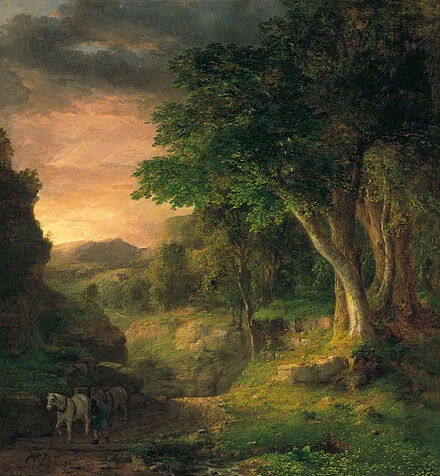
“In The Berkshires” (oil on canvas), also by George Inness
'City of sand'

Dune shack in Provincetown
“Provincetown is by nature a destination. It is the land’s end; it is not en route to anywhere else. One of its charms is the fact that those who go there have made some effort to do so. Provincetown is three miles long and just slightly more than two blocks wide. Two streets run its entire length from east to west: Commercial, a narrow one-way street where almost all the businesses are, and Bradford, a more utilitarian two-way street a block north of Commercial. Residential roads, some of them barely one car wide, run at right angles on a semiregular grid between Commercial and Bradford streets and then, north of Bradford, meander out into dunes or modest hollows of surviving forest, as the terrain dictates. Although the town has been there since before 1720 (the year it was incorporated) and has survived any number of disastrous storms, it is still possible that a major hurricane, if it hit head-on, would simply sweep everything away, since Provincetown has no bedrock, no firm purchase of any kind. It is a city of sand, more or less the way Arctic settlements are cities of ice.”
― Michael Cunningham, in Land's End: A Walk in Provincetown

On Commercial Street, in Provincetown

Until the late 19th Century, East Harbor opened into Provincetown Harbor, and there were no roads into Provincetown. East Harbor was diked in 1868, making way first for the railroad and then the automobile.
Or just brooding?

“The Sullen Sea” (oil on Masonite), by Mary Shore (1912-2000), at the Cape Ann Museum, Gloucester, Mass.
Ricky Riley: Riots are very American

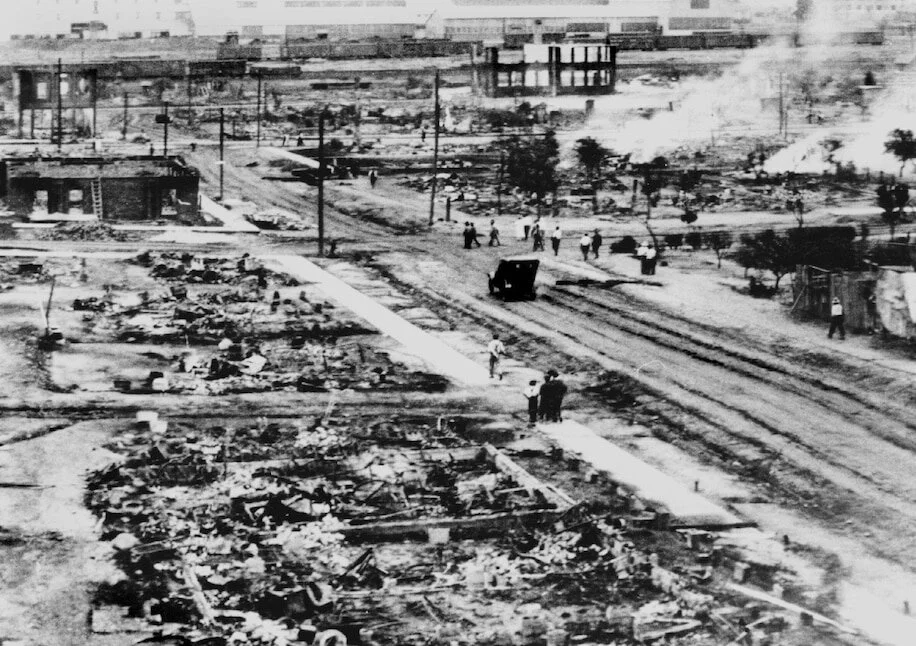
The aftermath of the riot by whites in Tulsa, Okla., in 1921, in which whites massacred hundreds of black people and destroyed much of their property.
Via OtherWords.org
Following the police killings of George Floyd and Breonna Taylor, national unrest has brought millions of protestors out from coast to coast. Most have been peaceful — but not all.
Cop cars and police precincts have been set ablaze, stores looted and vandalized, statues memorializing racists toppled. The police themselves have been repeatedly caught on video instigating violence and using military-grade weaponry against protesters.
Critics of the protests have focused entirely on the looting, often ignoring police brutality. They’ll tell people to protest more like Martin Luther King, Jr., perhaps forgetting that he called riots “the language of the unheard” — and that King himself was assassinated.
These complaints lack a basic understanding of American history. Historically, peaceful protests are rare. And as a political act, they’re fairly new.
Looking back at the early days of the American republic, riots, rebellions, and acts of insurrection — from the Whiskey Rebellion under George Washington to Fries’s Rebellion under John Adams — were so commonplace that the Insurrection Act of 1807 had to be passed to suppress them.
From 1800 to 1850, race riots between freed African Americans and new immigrants like the Irish were frequent. An estimated 250 slave revolts were suppressed by extreme force. Meanwhile white Americans also found time to riot over rent, taxes, and land disputes.
The next 50 years were no different. Anti-immigrant and anti-Catholic “Know-Nothing” riots cropped up from Baltimore to New Orleans in the 1850s, while the Colfax massacre in Louisiana saw 100 black men killed by a white militia in 1873.
The labor movement brought further clashes. Chicago’s historic Haymarket Square riots of 1886 called for the eight-hour workday, while the May Day riots of 1894 shook Cleveland over extremely high unemployment. Throughout the early 1900s, police clashed repeatedly with steelworkers, mineworkers, and other unionists.
Black Americans were terrorized by whites all the while, including in two of the most notorious race riots in history: Florida’s Rosewood massacre and the destruction of Tulsa’s Black Wall Street.
Peaceful protests were not widely employed as a legitimate form of protest until the suffrage movement. But even then, peaceful protests were often met with the same vitriol as “violent” ones — especially when those protests were by people of color.
At the height of the civil rights movement in 1966, two-thirds of Americans had an unfavorable view of MLK in 1966. By the time he was assassinated, about 75 percent disapproved, according to a 1968 Harris Poll.
What followed? Riots. A wave of uprisings overtook 100 U.S. cities in wake of the slaying of King. But sometimes, riots work — these “Assassination Riots” in April 1968 led to the direct passage of the Civil Rights Act and Fair Housing Act.
The next year, a transformative LGBTQ civil rights movement began with the Stonewall Riot.
For a more recent example, former 49ers quarterback Colin Kaepernick attempted to resurrect an MLK-esque peaceful protest and was effectively blackballed from the NFL. The right ridiculed him and denounced his followers with extreme vitriol.
However, as the George Floyd protests unleashed a wave of anger, major cities announced plans to move funds out of their racist police departments. Other reforms followed, with Minneapolis even announcing plans to disband its police altogether.
But debating the effectiveness or morality of riot-like protests isn’t as important as examining who can riot historically and who can’t. White men achieved many political goals through rioting. And rioting by white sports fans is often less demonized than even peaceful protests by black and brown communities.
The real problem may be that some Americans don’t want marginalized people engaging in protests at all — “peaceful” or not.
Ricky Riley is an Atlanta-based journalist and educator.
Tough times for colleges
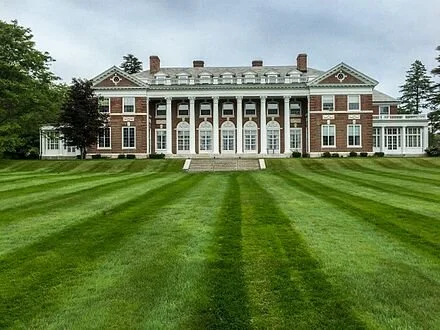
Whither small private institutions such as Stonehill College, in North Easton, Mass., one of whose buildings is seen above?
From Robert Whitcomb’s “Digital Diary,’’ in GoLocal24.com
Some students are suing, in class-action lawsuits, several New England colleges for refunds after these institutions shifted to remote (e.g., via Zoom and Skype) teaching as they stopped on-campus courses because of COVID-19.
I can’t say that I blame them, considering the astronomical cost of college these days. Screens are nowhere as good a learning setting as in person – learning from professors and fellow students. Among the institutions being sued are Brown University, Boston University and the University of Connecticut. Apparently small private colleges that may well soon go out of business are being left alone for now. Why drive the last nails into their coffins and then try to collect damages? Some of them were already on very thin ice because of declining demographics. You can guess their names in this region.
As colleges and universities agonize over whether to reopen their campuses for in-person instruction in the fall, they’ll bear in mind their legal exposure.
‘Twists and turns’
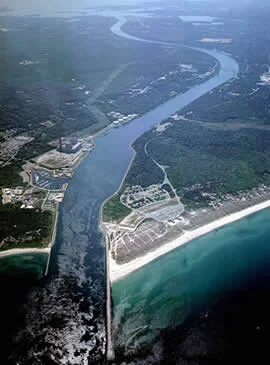
The East End of the Cape Cod Canal and Scusset Beach State Reservation
“I could not paint a better picture,
Than the one in front of me,
Of twists and turns of the canal,
Bordered by endless trees. ‘‘
— From “Herring Run at the Cape Cod Canal,’’ by Judith Kerttula
Llewellyn King: History shows that reform is highly perishable

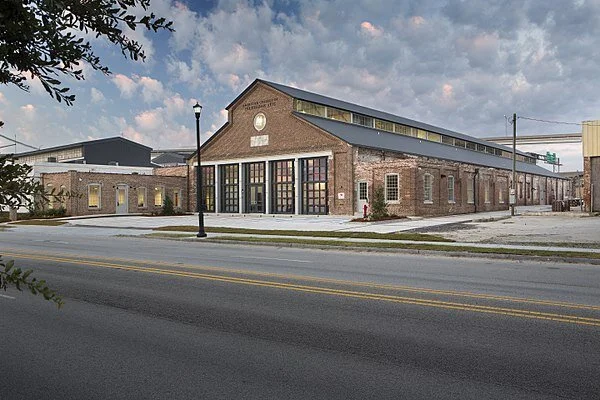
Beacon of learning, practicality and hope: American College of the Building Arts, in Charleston, S.C.
WEST WARWICK, R.I.
Reform is in the air. Beware of it. Often it evaporates as the generation that spawned it moves on.
I take you back to the 1960s, when reform was everywhere. We came out of that tumultuous decade with high hopes for a better deal. Some reform movements left a lasting impact, but others faded away.
Here, in no order, are what I see as the seminal reforming events of the ’60s.
The anti-Vietnam War movement; the environmental movement; the civil- rights movement; the women’s movement, and the prison-reform movement. Considering what’s happening on the streets of America now, it can be argued that the biggest disappointment was in civil rights, despite what’s been achieved.
To be sure, schools, including colleges, were integrated, and big institutions offered some colorblind promotion. Legislation guaranteeing civil rights, including voting rights, and banning overt segregation in housing, for example, was passed.
But social integration failed. After the riots of 1968, triggered by the assassination of Martin Luther King Jr., whites accelerated their exit from cities in droves for the suburbs, in “white flight.”
Much of the civil-rights legislation over time has been whittled away, particularly that associated with President Lyndon Johnson’s Great Society. It was often replaced with harsh policing and an attack on welfare.
It became a myth that The Great Society failed. It didn’t. The Great Society wasn’t given a fair shake before it was replaced with The Great Lockup Society.
Fear of drugs and related crime was greeted in the 1970s and 1980s with a philosophy that it was best to lock people up for a long time with mandatory sentencing and zero tolerance. The burden fell disproportionately on young African-American and Hispanic men.
The young people who’d marched around the White House in opposition to the Vietnam War, and belonged to what was called at the time “the new class,” were going to bring in a new society. They were articulate idealists who wanted a better world.
However, as other problems gripped the national attention, such as energy, the new class matured into the old class. They forgot the heady hopes of the ’60s when they’d dreamed of utopia.
Our politics hardened, too. The whole political apparatus moved to the right. If blacks were thought of at all by whites, it was as though their problems had been solved: Heck, there were black people all over television.
The big issues of health care and education weren’t addressed and if they were, the answer was unhelpful: private health care and private education.
We started graduating an almost unemployable class through the broken public-school systems. Then we said, “See, they’re unemployable, ignorant, and only fit for a few minimum wage jobs like hamburger flipping.” If you are born into poverty and have little enlightened parenting at home, failure is nearly guaranteed.
Not only are we graduating students who can hardly read, but we aren’t telling them what reading is about: living a whole life.
My wife and I were filming a television program at the American College of the Building Arts in Charleston, S.C., a few years ago. This private college should be a template for the future of small colleges. Students study liberal arts in tandem with a trade: blacksmithing, carpentry, classical architecture, plaster, stone carving and timber framing.
One student we interviewed -- who was a little older than most college students (like most of the student body) -- was an African-American who had served in the Marine Corps. “What do you like about college?” I asked. “Dickens,” he replied. He loved the literature component of the liberal arts education. Then, with a winning smile, he added, “They don’t teach that sort of thing in the high schools around here [Charleston].”
Students with a trade tend to start businesses. We were told that about a third of ACBA graduates start a small business within five years of graduation. Business is within the grasp of anyone who has a trade to sell, such as l carpentry, stone carving or metal-working.
Dignity is beyond price and it comes with success in small business. The key is the right kind of education: teaching downhome skills while lighting up the mind.
Llewellyn King is executive producer and host of White House Chronicle, on PBS. His email is llewellynking1@gmail.com, and he’s based in Rhode Island and Washington, D.C.
'Vermontiness'
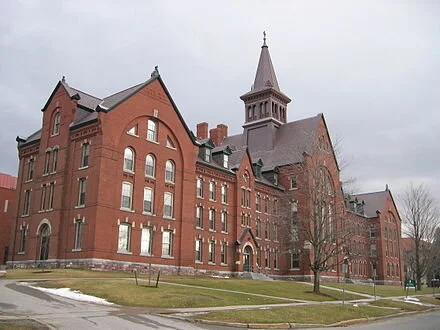
The University of Vermont’s Old Mill building, in Burlington
“In Burlington, I can call anyone anyone and learn from their experience. The degrees of separation are lessened here. There’s a shared Vermontiness.’’
— Marguerite Dibble, founder of Burlington-based GameTheory
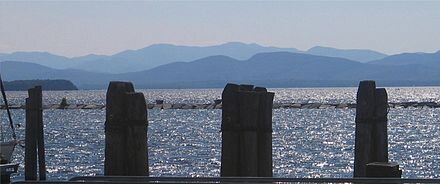
View of Lake Champlain and the Adirondacks from the Burlington waterfront
Study: Most Boston area COVID-19 infections came from Europe
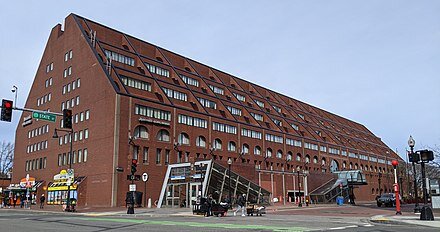
The Marriott Long Wharf Hotel in Boston, the site of a Biogen international meeting on Feb. 26-28 to which most early COVID-19 cases in Massachusetts have been traced.
From The New England Council (newenglandcouncil.com)
“Researchers at Massachusetts General Hospital (MGH) have published a draft of a new report tracing the beginnings of the outbreak of COVID-19 in the United States, especially in the Boston area. The report concludes that, in Greater Boston, most infections came from Western Europe. Read more from WBUR.’’
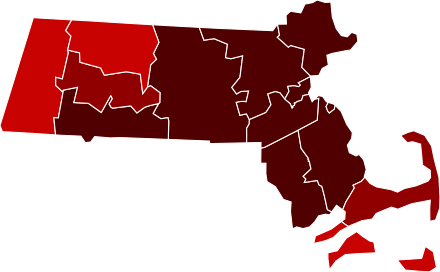
Map of the outbreak in Massachusetts by confirmed infections per 100,000 people (as of June 10). The darker the color, the more intense the case load.
‘Complacent in her captivity’

“Emily’’ (mixed media), by Joe Caruso, in Galatea Fine Art’s (Boston) online gallery.
This text runs with it:
“She stares out of a prison of an unknown making, complacent in her captivity. The woman's image in this construction seems unaware that time is passing. Once she was young and the world was open. Now she guards hidden memories.’’
Mr. Caruso lives in the Charlestown section of Boston, though his studio is in South Boston. Charlestown is the oldest part of Boston, having been originally laid out in 1629.
See:
joe-caruso-jwkc.squarespace.com
And:
galateafineart.com
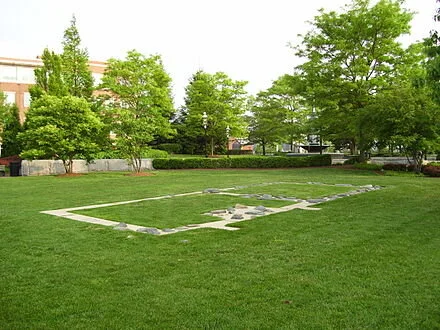
1629 site of the "Great House" of Puritan leader and the Massachusetts Bay Colony’s leading founder, John Winthrop (1587-1649) in City Square, Charlestown, uncovered during the Big Dig
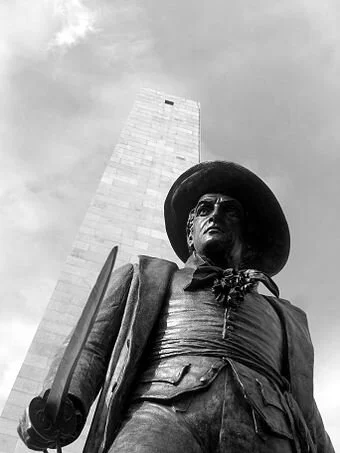
The Bunker Hill Monument and William Prescott Statue, in Charlestown. Prescott ( 1726 - 1795) was an American colonel in the Revolutionary War who commanded the Patriot forces in the Battle of Bunker Hill. Prescott is known for his order to his soldiers, "Do not fire until you see the whites of their (the English) eyes".
From weapon making to shopping

From “Work in Progress,’’ by Chantal Zakari, at Kingston Gallery, Boston, Oct. 21-Nov. 15.
The show explores, says the gallery, “the intertwined histories of the Watertown Arsenal, of the buildings and especially of the people who worked there. It is a visual metaphor of the overlap of the past history infused with the idea of war and the present transformation of the campus into a large shopping mall. The installation at Kingston Gallery has several components, including works on walls, video projections and an artist’s publication that will be concurrently distributed at the new arsenal.’’
See www.kingstongallery.com
The arsenal, on the north side of the Charles River, was operated from 1816 to 1968.

1919 map of the Watertown Arsenal

Building #71 at the arsenal
Health-care behemoth coming for a tiny state?

Behemoth as depicted in the Dictionnaire Infernal
From Robert Whitcomb’s “Digital Diary,’’ in GoLocal24.com
Good out of bad? Lifespan and Care New England, Rhode Island’s two big “nonprofit’’ hospital systems, have had to tightly coordinate their responses to the COVID-19 crisis – an experience that has led them to revive merger or at least “collaboration’’ plans. A merger might save on administrative and other costs borne by the public and enable the state to have a system big and strong enough to compete with the Boston health-care behemoth by maintaining a full-range of medical services and research in the Ocean State and by strengthening its only schools of medicine and public health, at Brown University. A merger might preserve a lot of jobs in Rhode Island. But at the same time, many jobs would presumably be lost as the merged company eliminated redundancies.
Of course, such a large and powerful merged entity would have to be carefully regulated. As Michael Fine, M.D., warned last week in GoLocal, such mergers have tended to raise health-care consumers’ costs because of the monopoly pricing-power created. And I wonder what gigantic golden parachutes, paid for indirectly by the public, would go to Lifespan and Care New England senior executives in a merger.
To read Dr. Fine’s comments, please hit this link.
Don Pesci: Conn.'s desperate restaurant owners wonder when...

How long?
VERNON, Conn.
On June 20, Connecticut will once again be open for business – sort of. The road to the grand opening has been a bumpy one full of false turns, sudden cul-de-sacs, and the driver of the bus headed towards a reopening of the state, now nursing a potential budget deficit of close to $1 billion, appears to be navigating irresolutely.
Will restaurants in Connecticut be fully opened on the date set by Gov. Ned Lamont, June 20, or not? Rhode Island Gov. Gina Raimondo, with whom Governor Lamont of has of late been having a Coronavirus shut-down bromance, already has turned the corner. Restaurants in Rhode Island, having got the jump on Connecticut, already are opened for business – sort of.
In a June 3 story, Hearst news noted that Connecticut restaurant owners were clamoring for an earlier opening date for indoor dining: "Some 550 businesses signed a petition by the Restaurant Association calling for a return to indoor dining on June 10. They include companies operating nearly 40 restaurants in New Haven and 30 in Stamford, from chains such as Buffalo Wild Wings, with locations in Stamford, Danbury, Milford and North Haven, to local haunts like Galaxy Diner in Bridgeport and upscale options such as Mediterraneo in Norwalk and Greenwich.”
Executive director of the Connecticut Restaurant Association Scott Dolch wrote to Lamont, “This is not hyperbole. Just this week and only steps from the Capitol, Firebox Restaurant in Hartford closed after 13 years in operation. They simply could not hold out any longer. Right now, every day counts for our industry.”
Tic Toc.
And then, as an aside that in some fashion must have penetrated Lamont’s soft shell, “Dolch noted that Rhode Island has already resumed indoor dining service, and that Connecticut’s coronavirus case count is better than that of New York and Massachusetts.”
Well, Lamont drawled, “Everybody wants to get going yesterday — I appreciate that,” Lamont said. “I am going to be a little cautious in terms of what the next round is. ... Maybe we can accelerate that a little bit.”
And then, as an aside that in some fashion must have penetrated Lamont’s soft shell, “Dolch noted that Rhode Island has already resumed indoor dining service, and that Connecticut’s Coronavirus case count is better than that of New York and Massachusetts.”
"’I've just seen tens of thousands of people protesting in New York City — thousands more in Boston. Neither of them have opened up any of their restaurants - they haven't even opened for outdoor dining that I know of as yet,’ Lamont said. ‘So I want to be very careful before we open our restaurants and invite people from the whole region here.’"
That’s a NO to Dolch and his 550 business petitioners.
Dolch and Connecticut restaurant owners really have nowhere else to turn for succor. In ordinary times, Dolch’s petitioners might have curried support among a dwindling number of legislators in the General Assembly who do not want Connecticut to be eating Rhode Island’s dust, but the General Assembly has put itself in suspended animation until it once again is called into service by the governor, and Lamont’s extraordinary autocratic powers do not lapse until September. Already – someone is keeping count – Lamont ranks fourth in the nation among governors who have issued the most executive orders, and he has three months to go before he runs out of autocratic gas.
Other problems may be looming on Connecticut’s dark horizon.
On June 4, the Lamont administration sent a notice around to Connecticut’s media that his administration is establishing a program, called the Connecticut Municipal Coronavirus Relief Fund Program, in which the state will reimburse city and town governments for expenses related to the COVID-19 pandemic, according to a story in The Day of New London.
The program, administered through the Connecticut Office of Policy and Management, is setting aside $75 million to be distributed to municipalities in Connecticut, “part of $1.4 billion in Coronavirus Relief Funds the state has gotten from the federal government.”
The Connecticut Conference of Municipalities, according to The Day’s story, “said it is appreciative of the announcement but noted that federal guidelines recommend that 45 percent of the total $1.4 billion in Coronavirus Relief Funds, which would be $630 million, be spent on municipalities with populations below 500,000.”
There is, a reader who has successfully passed fourth grade exams in basic math will notice, a considerable difference between the $630 million the Feds expect Connecticut to distribute to its towns in Coronavirus Relief Funds and the planned Lamont distribution of $75 million. Some sharp-eyed accountant in Washington, D.C., is likely to notice the disparity and – maybe – cut Coronavirus funding to the Connecticut proportionally.
The national government now has a debt of some $26 trillion, and every penny helps.
Don Pesci is a Vernon-based columnist.
Reasonably tough

“Your true Yankee is always reasonable — always — even at the moment of unsheathing his sword, or pulling a hair trigger.’’
— John Neal (1793-1876), in The Down Easters. He was a Portland, Maine-based writer, critic lawyer and architect.
MFA to buy works of 2 dozen contemporary artists
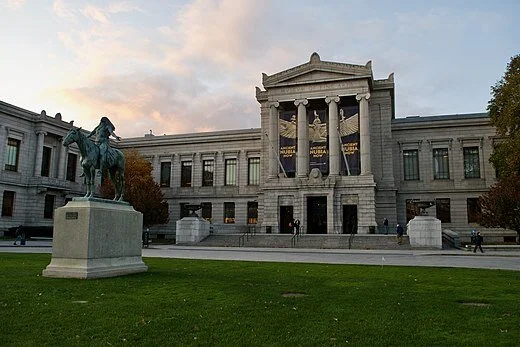
The front of the Museum of Fine Arts, Boston
The New England Council (newenglandcouncil.com) reports:
“Despite remaining closed to visitors, The {Boston} Museum of Fine Arts (MFA) has pledged to purchase the works of two dozen artists to grow its contemporary art exhibitions.
“All of the 24 artists selected live in the United States, with more than half of them originally from the Boston area. In addition to expanding the number of works in the museum’s contemporary art collections, the new works will offer new perspectives within each of their practices. Further, the initiative will support the work of emerging artists in the area. The museum will begin acquiring the pieces this month.
“‘Contemporary artists are part of the fabric of our community, and essential to who we are as an institution. Their commitment, innovation and engagement with the world inspires us in times of challenge,’ said Matthew Teitelbaum, the MFA’s director.
“We need artists’ voices to enhance the stories we share in our galleries and the connections we make with our visitors. With lifetime memberships for artists in our collection, we underscore the importance of artists in the life of our museum and our communities.”
“The New England Council congratulates the MFA for this expansion and for supporting artists during a time of financial hardship. Read more in The Boston Globe.’’

At the MFA, “The Fog Warning” (1885), by the American (and particularly New England) painter Winslow Homer (1836-1910).
'Or an Eastern dream'

THESE things I remember
Of New England June,
Like a vivid day-dream
In the azure noon,
While one haunting figure
Strays through every scene,
Like the soul of beauty
Through her lost demesne.
Gardens full of roses
And peonies a-blow
In the dewy morning,
Row on stately row,
Spreading their gay patterns,
Crimson, pied and cream,
Like some gorgeous fresco
Or an Eastern dream.
Nets of waving sunlight
Falling through the trees;
Fields of gold-white daisies
Rippling in the breeze:
Lazy lifting groundswells,
Breaking green as jade
On the lilac beaches,
Where the shore-birds wade.
“A New England June,’’ by Bliss Carman (1861-1929), a once famous Canadian poet who spent much of his life in New England.